What Is Heart Rate Variability (HRV) — And Why It’s an Important Health Metric You’re Not Tracking
- Brain Fitness, Brain Health, Brain Performance, Education, Health and Wellness, Technology
Share this post on social media
Most people measure their health in obvious ways: weight, blood pressure, cholesterol, resting heart rate. These metrics matter — but they tell you what’s happening in your body right now. They don’t tell you how well your body is adapting to everything life is throwing at it.
That’s where Heart Rate Variability comes in.
HRV is one of the most powerful and sensitive indicators of your overall health and resilience, and for most people, it’s completely invisible. That’s about to change.
Heart Rate Variability (HRV) is the measurement of the variation in time between consecutive heartbeats.
Your heart doesn’t beat like a metronome. Even at a steady resting rate, the actual intervals between each beat fluctuate slightly — sometimes by milliseconds. That variation isn’t random noise. It’s your nervous system at work, constantly fine-tuning how your heart responds to the demands of your body and environment.
Higher variability means your body is responding fluidly to changing conditions — a sign of adaptability, resilience, and recovery capacity.
Lower variability means your nervous system is locked in a more rigid, stressed state — a sign that your body is working harder than it should be just to maintain equilibrium.
In short: HRV is a window into how well your body is coping.
HRV is a direct reflection of the autonomic nervous system (ANS) — the part of your nervous system that operates below conscious control, regulating everything from heart rate and breathing to digestion and immune function.
The ANS has two main branches:
The sympathetic nervous system accelerates the body — increasing heart rate, sharpening focus, mobilizing energy. This is your “fight or flight” response. It’s essential, but it’s meant to be temporary.
The parasympathetic nervous system restores the body — slowing the heart, promoting digestion, facilitating repair and recovery. This is the branch responsible for deep sleep, cellular restoration, and long-term health maintenance.
In a healthy, well-regulated system, these two branches communicate constantly — creating that natural variability between heartbeats. High HRV reflects strong parasympathetic activity and a responsive, well-balanced ANS. Low HRV often indicates the sympathetic system is dominating — your body stuck in a prolonged stress response.
This is why researchers and clinicians have come to regard HRV as one of the most reliable non-invasive markers of overall health status.
Your HRV is dynamic. It changes from day to day and even hour to hour based on what your body is experiencing. Understanding what drives those changes is the first step toward using the data meaningfully.
Factors that typically lower HRV:
Factors that typically raise HRV:
Notice that list. Many of the most powerful drivers of healthy HRV are behavioral — things you can directly influence with the right tools and habits.
HRV naturally rises during deep, restorative sleep — a sign the parasympathetic system is doing its job. Consistently low HRV at night is one of the earliest indicators that your sleep is not as restorative as it needs to be, even when you think you’re getting enough hours.
Chronic psychological stress is one of the most significant drivers of HRV suppression. Research consistently shows that people with anxiety disorders, depression, and burnout tend to have lower HRV. Conversely, practices that reduce stress — meditation, relaxation techniques, breathwork — reliably increase HRV over time.
Athletes have used HRV for years as a precision tool for training load management. A higher-than-usual HRV reading on a given morning suggests the body is recovered and ready for intensity. A lower-than-usual reading suggests the body needs more time — and pushing through may increase injury risk or lead to overtraining syndrome.
The connection between HRV and brain function is well established. Higher HRV is associated with better working memory, attention, cognitive flexibility, and emotional regulation. This makes sense: a well-regulated autonomic nervous system supports better blood flow, lower cortisol, and a brain that’s ready to perform.
Reduced HRV is associated with increased risk of cardiovascular disease, metabolic disorders, and all-cause mortality. While HRV alone isn’t a diagnostic tool, tracking it over time provides early warning signals that the body may be heading in an unhealthy direction — long before more serious symptoms appear.
At BrainTap, HRV isn’t just a metric we monitor — it’s one we actively work to improve.
BrainTap’s Audio-Visual Brain Entrainment (AVBE) technology uses a proprietary blend of light frequencies, binaural beats, guided visualization, and holographic music to guide the brain into deeply relaxed, balanced brainwave states. And the effects on HRV are measurable.
In a clinical trial published in Global Advances in Health and Medicine (Vol. 9, 2020), a single BrainTap session produced a 38.5% improvement on the stress index scale and significantly increased both heart rate variability and parasympathetic activity.
Across 12 clinical studies, BrainTap’s technology has demonstrated:
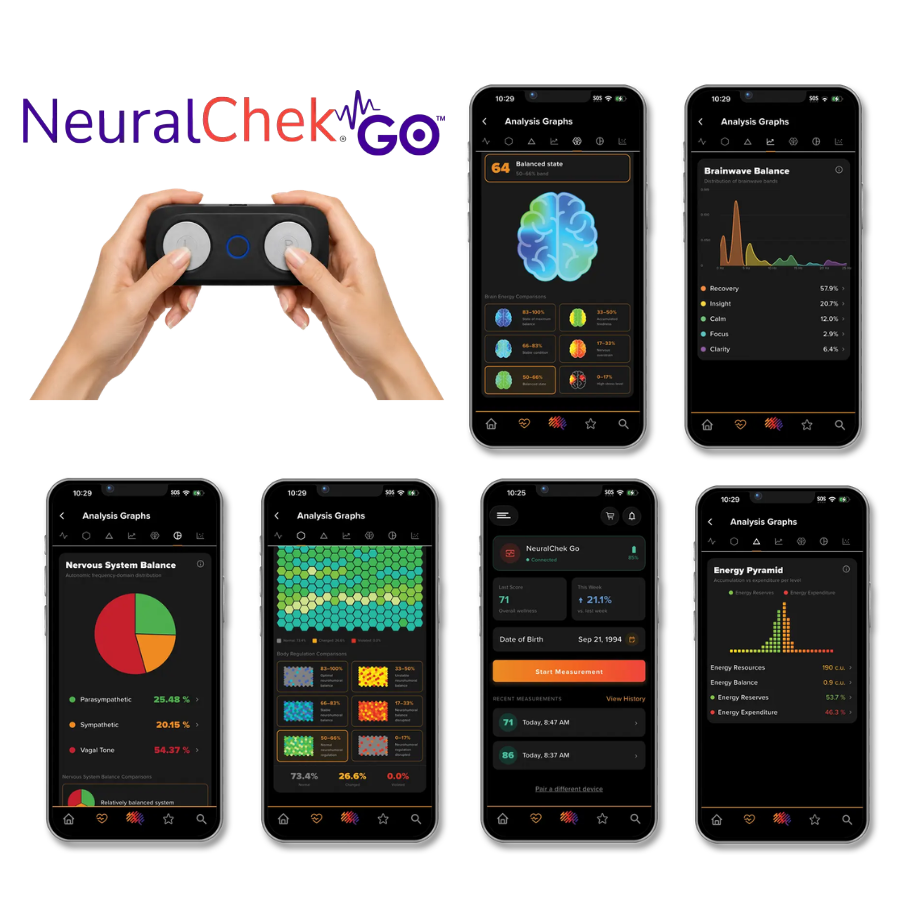
This research underpins the development of NeuralChek Go — BrainTap’s purpose-built HRV monitoring device that makes it possible to track these improvements in real time, from home.
One of the most important things to understand about HRV is that it’s highly individual. There is no universal “good” or “bad” number. What matters is your baseline — and how your readings change over time relative to that baseline.
A competitive endurance athlete may have a resting HRV of 90 milliseconds. A healthy but sedentary adult might be at 45. Neither number is inherently better without context. What’s important is:
This is why NeuralChek Go is built around the concept of awareness before optimization. The first goal isn’t to improve your numbers — it’s to understand your personal patterns so that the numbers become genuinely meaningful to you.
Step 1: Establish your baseline.
Scan daily at the same time each morning, ideally before coffee, exercise, or significant activity. Do this for at least one week before drawing any conclusions.
Step 2: Notice what influences your numbers.
Start connecting your HRV data to life events. Did a late night lower your reading? Did a stressful meeting affect your afternoon scan? Did a BrainTap session before bed improve your morning numbers?
Step 3: Use the data to make smarter decisions.
Over time, your HRV trend becomes a real-time readout of how your lifestyle choices are affecting your body. Use that data to guide decisions around training intensity, sleep, stress management, and recovery.
Step 4: Watch what improves it.
As you build consistent habits — regular BrainTap sessions, better sleep hygiene, stress reduction practices, proper recovery — watch how those habits move your HRV trend in a positive direction.
Heart Rate Variability is one of the most information-rich, science-backed health metrics available to you — and until recently, accessing it required expensive equipment or clinical oversight.
NeuralChek Go changes that. With a fast, accurate daily scan and the full context of the BrainTap ecosystem behind it, you now have everything you need to start understanding — and improving — one of the most important signals your body produces.
Your body has been communicating all along. Now you can listen.
Discover NeuralChek Go at braintap.com
References:
Global Advances in Health and Medicine, Vol. 9, 2020 — “Effect of a Single Audio-Visual Brain Entrainment Session on Heart Rate Variability: a clinical trial with 100 adult volunteers”
BrainTap Technologies research library: research.braintap.com
BrainTap Technologies is the leader in brain fitness, combining proven neuroscience with innovative technology to help people think, sleep, and perform better. Learn more at braintap.com.
Elevate your mind: Subscribe to our newsletter for insights on brain health, cutting-edge research updates, and personalized session suggestions to help you unleash your ultimate potential!
We only send what matters—no spam, no sharing. We promise.